
Egg White Powder Macarons
This post may contain affiliate links.
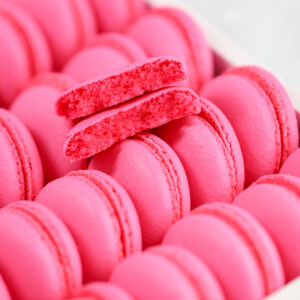
Did you know you can make macarons with egg white powder, also called Albumen? That’s right, in my recipe, fresh egg whites can be replaced with powdered egg whites to make stable meringue. This will be a “game changer” for many bakers, because egg prices are growing and shortages are happening very often. I am sharing a simple Egg White Powder Macarons recipe that uses egg white powder and can be made in a home oven.

Why You’ll Love This Recipe
- This recipe requires no eggs. Eggs are replaced with water and egg white powder (Albumen).
- Fresh eggs are not always available and can be expensive around holidays.
- Macaron shells come out full, not hollow.
Ingredients

- Albumen: Egg white powder. I used Judee’s dried egg whites.
- Water: Clear water around 40°C.
- Sugar: White granulated sugar and powdered sugar. I use Domino products.
- Flour: Almond flour. Make sure you are using almond flour and not almond meal. You can also use hazelnut or pistachio flour to make macarons.
- Food Coloring: Water-based food coloring. I used Haute.
How to Make This Recipe
Measure all ingredients using a digital kitchen scale and prepare all tools. Make sure the mixing bowl and whisk of the stand mixer are dry and clean.

In the mixing bowl of a stand mixer, add water, egg white powder, and powdered food coloring. Whisk and let it sit for a few minutes.

Whip on medium-high speed for a few minutes, then add sugar in a few parts. Set up a timer for 15 minutes, do not change the speed.
In a separate mixing bowl, sift almond flour and powdered sugar. You can sift a few times if necessary and discard any large pieces of almonds.

Meringue should be stable, shiny, and have stiff peaks.

Add dry ingredients to the meringue.

Switch the whisk to the pedal attachment in the stand mixer.

Pulse mixer for a few seconds, then stop. Repeat a few times. Do not mix for too long, as it is very easy to overmix the batter.

Continue mixing macaronage with the spatula. The goal is to remove air bubbles from the batter without overmixing. The batter is ready when it flows fast from the spaula. Check the batter consistency every few folds.

Transfer macaronage into the prepared pastry bag with a round piping tip. Pipe macaron shells on the silicon baking mat. Hold the pastry bag perpendicular to the mat. Pipe the batter into 1-inch diameter circles. Use the template if needed.

Baking Macarons
Transfer the baking mat to the baking tray. Top the tray on the countertop a few times. Do not forget to rotate the tray.

You can also “make a wave” with the baking mat instead of topping the tray. Be very careful not to fold the mat.

Use a toothpick to remove any air bubbles that appear.
Let macarons dry (rest) on the countertop for 10 -15 minutes, then check if they are ready to bake. The top of the macaron shell should be dry when you touch it with your finger. You can also try to bake without resting and see the result. Resting time or not resting at all before baking can be different, depending on your environment you live in.
Bake macarons in the preheated oven to 300°F for 14-16 minutes. I found that macarons made with egg white powder take a few minutes longer to bake in my oven. Macarons are baked when they are not wiggly when you touch them with your fingers.
After baking macarons, remove the tray from the oven and macarons cool on the baking mat. After that, pair macaron shells with a similar sizer and fill macarons with your favorite filling. It can be American Buttercream, Ganache, or Caramel. I have many different recipes with fillings for macarons.

Expert Tips
- Use a digital scale and measure all ingredients correctly. A few grams can affect the final result.
- Do not use too much food coloring, especially liquid ones. It can make macaron shells look “wet and oily”.
- Practice. Do not be afraid to try this recipe with no resting method. It may work for your environment and your oven.
- When you are making this recipe for the first time, make sure to take notes. This will help to avoid mistakes in the future.
- Do not give up! Macarons are worth the effort! My first macarons were not perfect.

Recipe FAQs
Very simple: The egg white is known as the albumen, which comes from albus, the Latin word for “white”. Please do not mistake it with Albumin, which is a specific type of protein that is soluble in water.
Macrons can be cracked if you do not rest long enough before baking.
There are a few reasons for this. The most common are unstable meringue, incorrect folding technique, and the wrong oven temperature.
My Latest Video



If you make these Egg White Powder Macarons, please tag me on social media and make sure to leave a rating below. I would love to see your creations!
Recipe
Egg White Powder Macarons
Equipment
- 1 stand mixer or electric hand mixer
- 1 kitchen scale
- 1 fine mesh strainer
- 1 spatula
- 1 pastry bag
- 1 round pipping tip
- 2 silicin baking mat
- 2 baking tray
Ingredients
Egg White Powder Macarons
- 110 g water about 40oC
- 20 g egg white powder (albumen)
- 1 g food coloring
- 150 g white granulated sugar
- 200 g almond flour
- 100 g powdered sugar
Instructions
How to Make Egg White Powder Macarons
- Measure all ingredients using a digital kitchen scale and prepare all tools. Make sure the mixing bowl and whisk of the stand mixer are dry and clean.
- In the mixing bowl of a stand mixer, add water, egg white powder, and powdered food coloring. Whisk and let it sit for a few minutes.
- Whip the mixture on medium-high speed for a few minutes and start adding sugar in a few parts.
- Set up a timer for 15 minutes, and continue whipping. Do not change the speed.
- In a separate mixing bowl, sift almond flour and powdered sugar. You can sift a few times if necessary and discard any large pieces of almonds if necessary.
- Meringue should be stable, shiny, and have stiff peaks. Switch the whisk to the pedal attachment in the stand mixer.
- Add dry ingredients to the meringue. Pulse mixer for a few seconds, then stop. Repeat a few times. Do not mix for too long, as it is very easy to overmix the batter. Continue mixing macaronage with the spatula. The goal is to remove the air bubbles from the batter and not overmix. The batter is ready when it flows fast from the spaula. Check the batter consistency every few folds.
- Transfer macaronage into the prepared pastry bag with a round piping tip.
- Pipe macaron shells on the silicon baking mat. Hold the pastry bag perpendicular to the mat. Pipe the batter into 1-inch diameter circles. Use the template if needed.
- Transfer the baking mat to the baking tray. Top the tray on the countertop a few times. Do not forget to rotate the tray. You can also "make a wave" with the baking mat instead of topping the tray. Be very careful not to fold the mat.
- Use a toothpick to remove any air bubbles that appear.
- Let piped macaron shells dry (rest) on the countertop for 10 -15 minutes, then check if they are ready to bake. The top of the macaron shell should be dry when you touch it with your finger. You can also try to bake without resting and see the result. Resting time or not resting at all before baking can be different, depending on your environment you live in.
- Bake macarons in the preheated oven to 300°F for 14-16 minutes. I found that macarons made with egg white powder take a few minutes longer to bake in my oven. Macarons are baked when they are not wiggly when you touch them with your fingers.
- After baking macarons, remove the tray from the oven and cool the macaron shells on the baking mat.
- Pair macaron shells of a similar size and fill them with your favorite filling.


I made your recipe and it turned out perfect. The first time, I got small holes in the shells, and I realized the reason was my oven temperature and air circulation.
The second time, I placed an empty tray on the top rack to protect the shells and help them rise more evenly, and it worked perfectly.
Guys, the recipe is great, but you also need to understand other factors such as room temperature, oven temperature, strong meringue, resting time, the quality of the egg white powder, and overall technique. Macarons are very sensitive, so small details make a huge difference.
Thanks for sharing your experience and recipes. Your egg white powder recipe helped me solve my problem of wasting egg yolks, and I finally achieved the perfect shells I had been obsessed with getting.
Thanks again!
Thank you so much for your review. I am so happy to hear that!
Marina, I was a skeptic but I had some fresh inexpensive powder bought from Amazon (Talcufon brand) and gave it a try. It worked beautifully! I usually use the swiss method but will try this for my next few batches. Thank you for sharing!
I am so happy to hear that! Thank you so much for sharing!
Thanks for the recipe, i will try for sure, as i do only italian method , live your flavour recipes for Macarons , really yummy and easy to prepare, i like Mango and Red Velvet
Thank you for the review! I am so happy to hear that.
My macarons turned out perfectly using this recipe!! I’ve been baking Italian macarons for 8 years and sometimes they turn out and sometimes depending on the temperature, humidity and other factors they won’t turn out. I’ve been wanting to try the dried egg white macarons for while now and finally did and definitely will keep baking using this recipe! Thank you for sharing!
I am so happy to hear that! Thank you for sharing!